Beached
Seashore containers for the beached human heart

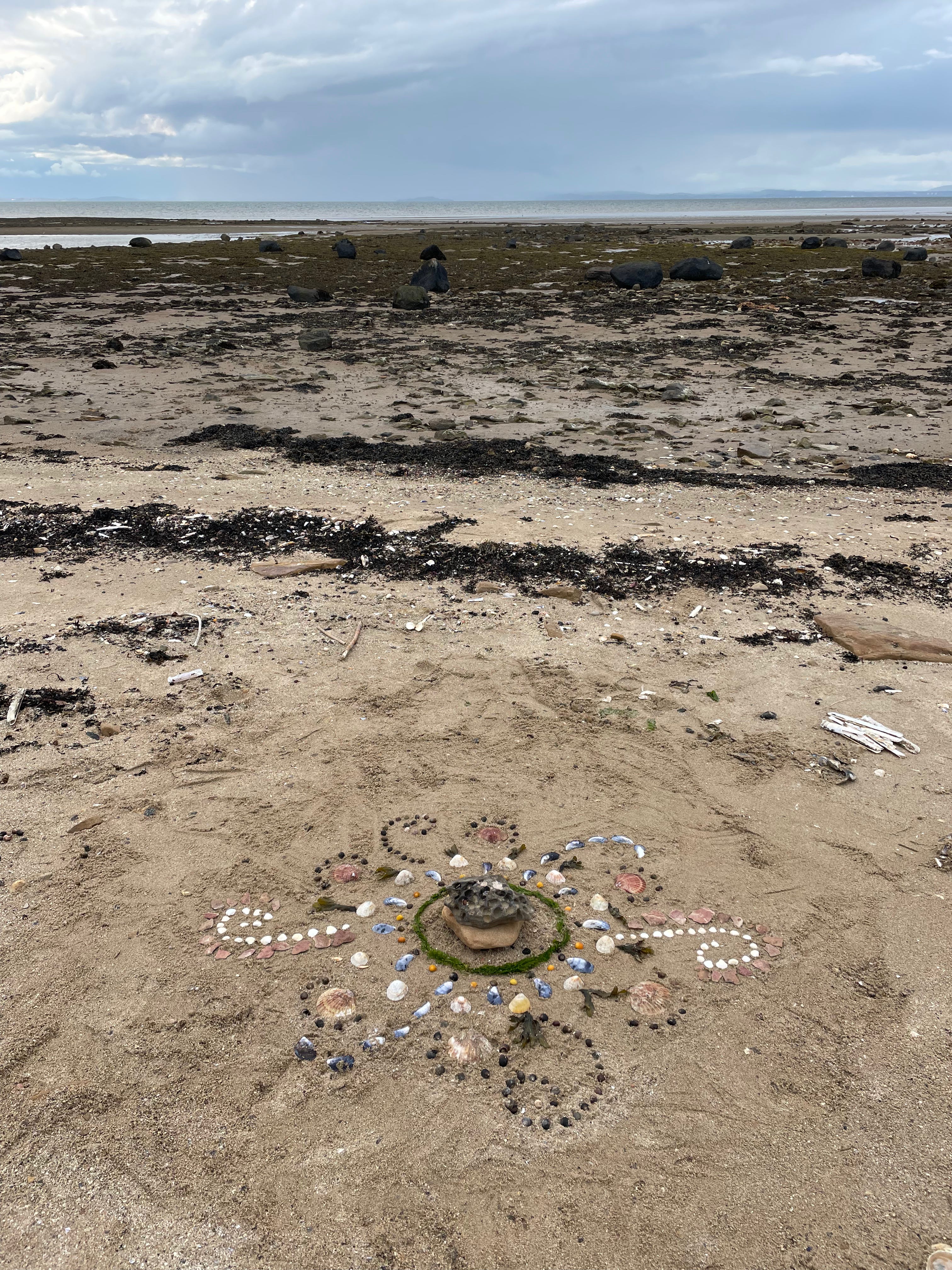
Open or closed? she asks.
Open, I say, though the urge to clam up altogether is about as intense as it’s ever been.
We let the outer edges of our improvised shell mandala spiral and spool onto the shore at Longniddry.
It’s a scruffy East Lothian beach, with banks of seaweed, sharp rocks in the shallows, and strange concrete WWII coastal defences. It doesn’t have the ice cream van of Gullane’s soft sands or the wide arc and surf of Belhaven. But we both love it.
She’s the first one to answer the phone that afternoon after he disappears suddenly from my life. Says, come on over, darling.
I pick her up and we drive towards the river.
Every so often she’ll post a photo into WhatsApp of a worktop wonder, a dinner plate blessing - strawberry stalks and orange peel, carrot curls and rose petals, pecans and pepper slices - fashioned into whirling kitchen galaxies. She’s an artist. But this is the kind of imagining and making that’s not only a profession but an inner state of being.
She knows exactly what my freshly beached heart needs: busy hands.
We stoop and the sand is full of colour: kelp and sea lettuce, cockles and cowries and mussels, in a hundred shifting shades of shell. We sort them into wee clumps of colour.
I place an old oyster on a stone at the centre. Until the 18th century, this stretch of the Forth estuary housed Europe’s most abundant flat oyster grounds. Back then they were the food of ordinary people not exclusive diners, until industrial dredgers muscled in to scrape them off the seabed to the point of decimation. It wasn’t until 2023 that native oysters were reintroduced into the Firth of Forth as part of conservation efforts.
I build a green arc around the oyster shell, a sort of cellular wall. Concentric circles of shells arrange themselves around it by colour, size and shape, as the wind scuttles along the front, catching the feathery weeds and grasses.
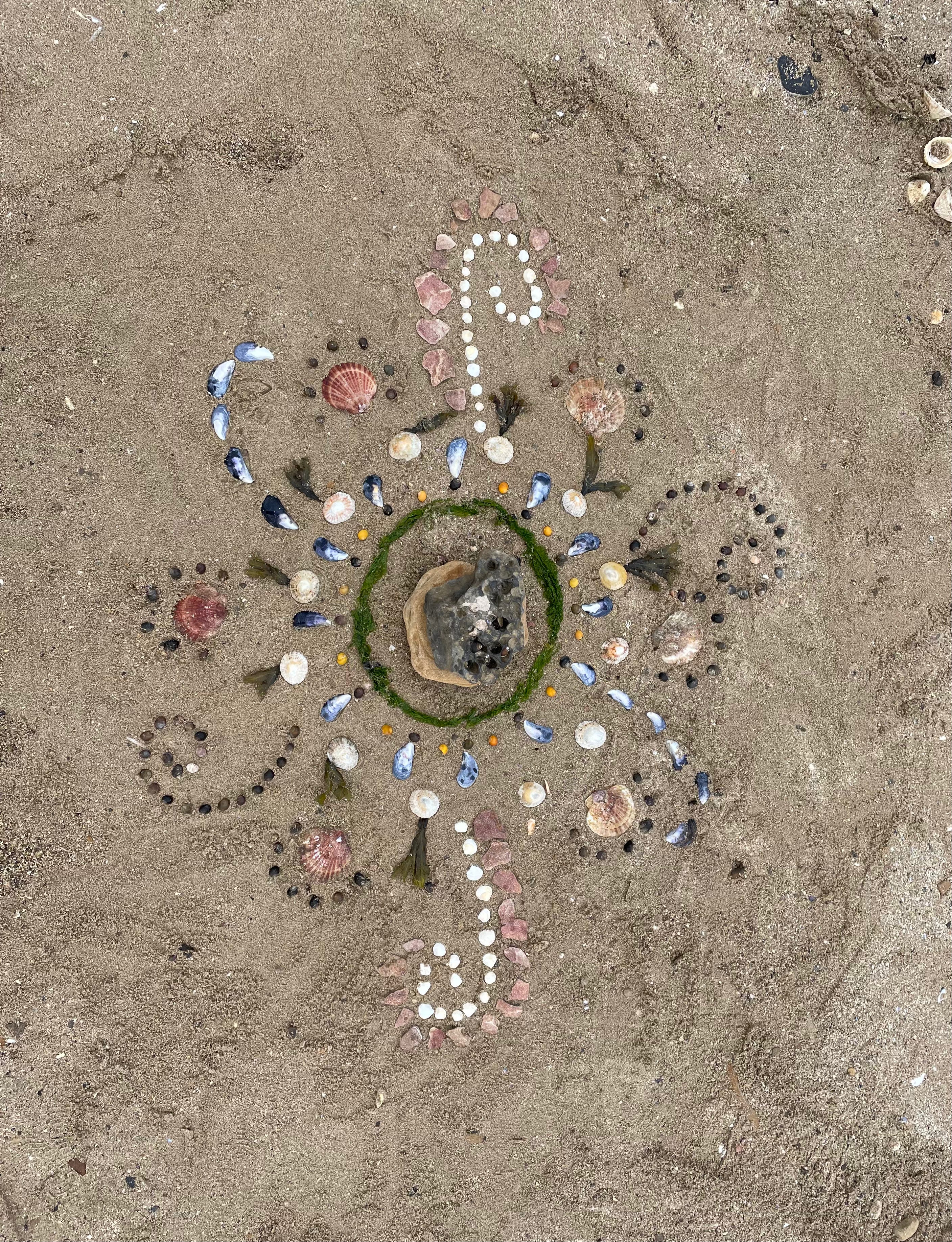
When we’re done, I pour my grief and utter bewilderment into the crooked fold of it. And then we drive home.
Overnight the tide washes the mandala away like a childhood holiday sandcastle. And I think as I lie awake unable to settle - that’s how it is. To try to make a beautiful thing together and then experience its erasure is a lesson in living.
Some forces are simply bigger than others.
The sea.
The wind.
Sadness.
Fear.
Open, I say to myself, keep it open.
I go back to the beach at the turning of a year during which, though we move through many of the same streets, I haven’t encountered the man who left even once. A blessing on us both, I can see now. I’m on my own this time, and the shore is a different place. As am I.
There’s no seaweed to speak of. A mere handful of sharp-nosed augur shells. A dearth even of mussels. But it’s busy, busy, busy with couples, dogs, horses. I see myself for a moment from outside, a lone woman in her fifties fastidiously gathering and sorting shells into wee piles.
I push past the oddness.
It’s simply a matter of attention, of course. Look again, take your time, and there are tiny orange periwinkles, razor shells and limpets. My eye is drawn to a solitary tiny rose coloured shell, no bigger than a fingernail. Is this what it’s like to find someone to love, and to be loved by? One teeny speck on a long windswept beach?
I hope not and toss it back into the hash.
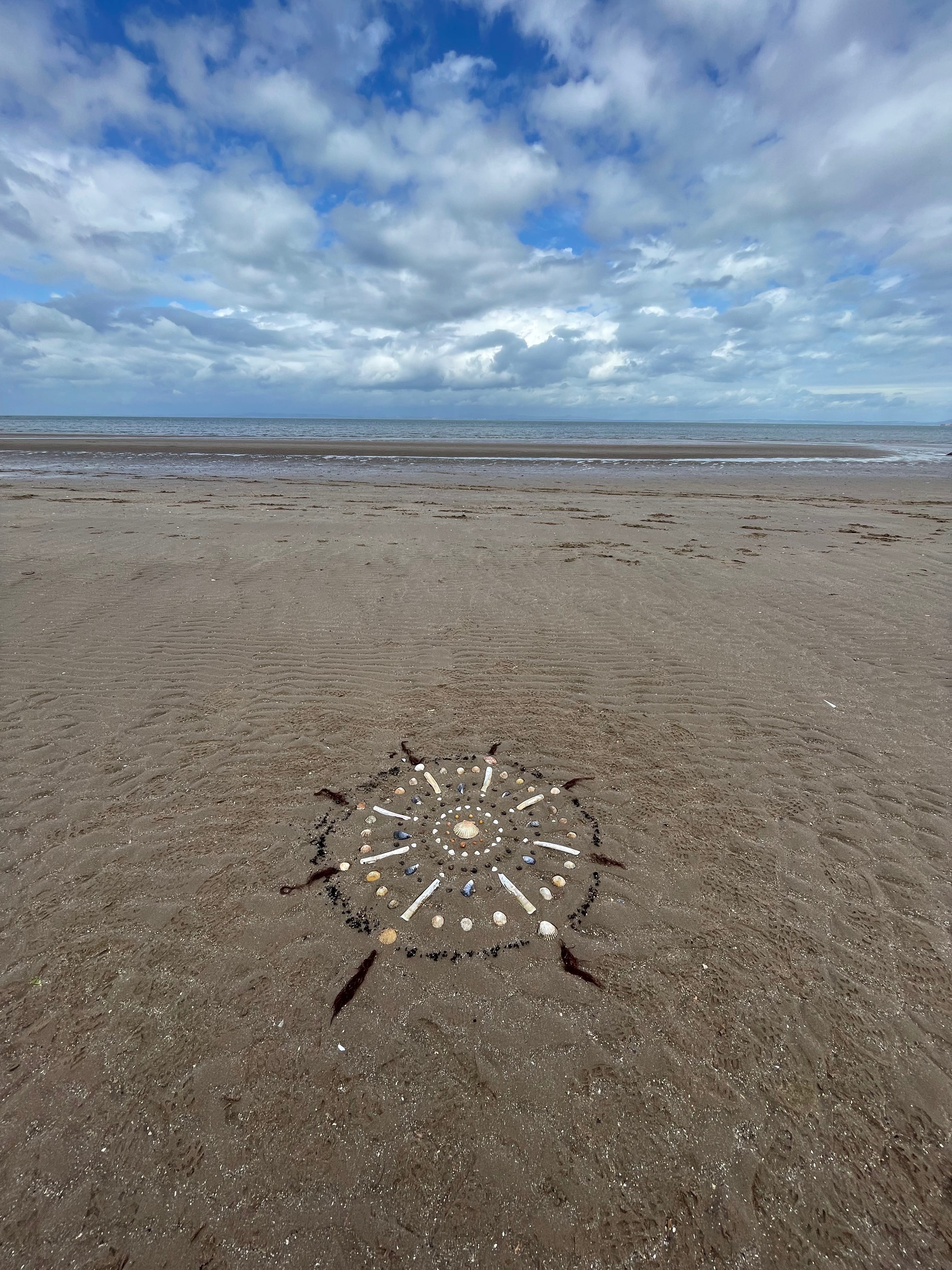
Then I start at the centre with a single Queen scallop and work my way out. Openness is great. Porousness less so. This mandala reprise wants to be a little more contained than the last, yet with more air inside, and room to breathe. And that’s just fine.
As it nears completion, I scoop up a handful of black sand, fragments from the ancient Forth coal seam. I scatter it round the edges like an unexpectedly delicate sort of membrane, and allow a few fronds to reach beyond, to what’s still to come.
For a few moments, I consider the shape on the shore, and feel the weight of what’s gone.
It’s ok. It’s actually ok.
Then I shake the sand from my fingers and head home.
Thanks to the Fruitmarket in Edinburgh for the support of the Dr Gavin Wallace Fellowship - Attached to Land - which comes to a close for me this summer. The past year of my life has thrown a few curveballs at my original hopes and intentions for my writing. But it’s been an almighty gift to have somewhere to interrogate my own lost-ness and to write my way towards - fingers crossed - steadier ground.
Lost-ness arrives as a stranger and outstays its welcome... until one day you look up, and it's gone...
Hello Karine,
East Lothian is a place I know well, and long for now that my visits there have ended.
Like you, I mourned loss at those beaches.
Together, Irene and I shared wonder at nature along that coast and taught each other what the other could see; me, geology, Irene, birdlife and botany, so that as well as delight at what was in front of us, we also saw the story of the landscape, and shared that with love.
You’ll know/knew us both by sight - we are/were regulars when you play/played - losing someone makes such bastards out of the sentence tenses when you speak of them; each qualification of present to past is another reminder, and a fresh stab to the heart.
My geology is functional rather than practised, so I have learned from your writings here; thank you for that. Should I ever get back to those beaches, I can now know more of what I’ve only looked at and wondered about till now. As you’ve found; reading and comprehending the landscape around you gives you satisfaction, a sense of the place and more than that, the deep time that’s gone before and shaped what is here now.
On a lighter note, I visited Siccar Point at the start of the year before the trail was built. Immediately post-Christmas the fields were piled high with unwanted brussel sprouts which the sheep were feasting on. Consequently, the air was heavy with the smell of sprouts, both pre- and post-processing by the sheep. Having grown up next to a farm I am used to the countryside being smelly, so there were memories of a different sort mingled with the wonder at the story in the rocks there. But the appreciation of how the story in the rocks at Siccar Point changed our view of, well, life, the universe and everything is humbling.
Thank you for your writings; I hope they are helping you; they’re certainly helping me cope with the grief that follows loss.
Russell